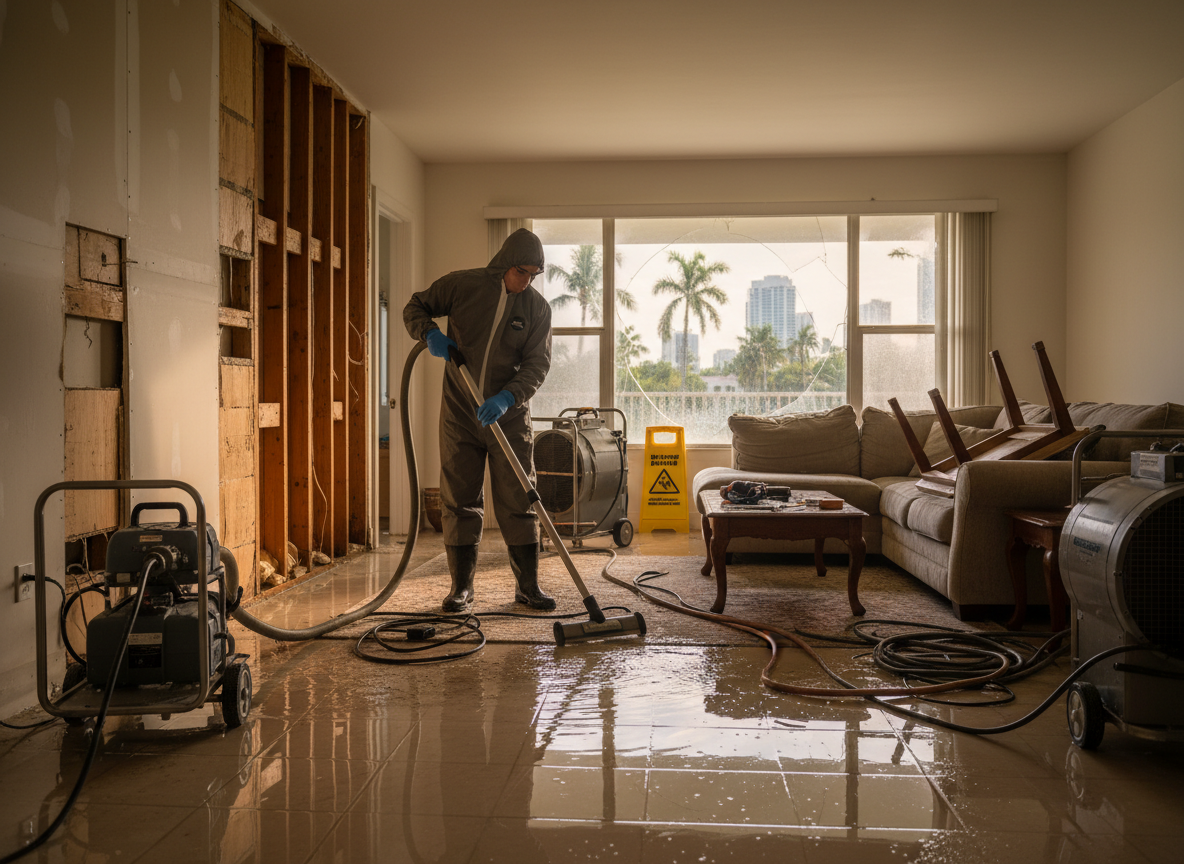
Miami’s tropical monsoon climate brings heavy summer downpours that overwhelm older drainage systems in neighborhoods like Overtown and Little Havana. Concrete-block homes built before 1970 often have slab-on-grade construction with limited vapor barriers, so water migrates quickly into subfloors and walls. Technicians must pull baseboards early and use moisture meters on both sides of interior partitions to catch hidden saturation before mold sets in within 48 hours.
Brickell and Downtown Miami high-rises present different challenges: pressurized plumbing risers and rooftop mechanical rooms can leak into multiple units below. Restoration crews coordinate with building management to isolate zones, use negative-air machines on occupied floors, and document every step for insurance adjusters who know Miami-Dade County permitting rules. Failure to address the top-down migration path leaves owners with recurring claims.
Coconut Grove and Coral Gables properties sit on limestone and sandy fill that retains moisture after storm surges or canal overflows. Crews deploy industrial air movers and low-grain dehumidifiers sized for the actual cubic footage, then monitor daily readings until drywall and hardwood reach manufacturer-specified moisture content. Skipping these steps in the region’s persistent humidity almost always leads to callbacks.
Technician insight
In Miami, the thing that catches most people out with Water Damage Cleanup is how fast the tropical humidity drives mold behind baseboards in pre-1970 concrete-block homes common in Little Havana and Overtown; if you don’t pull trim and meter both sides of the wall the first day, you’ll be back in two weeks.
Wynwood Loft After Summer Storm
A ground-floor loft took several inches of rainwater through an old roof drain. Extraction removed the standing water, but moisture had wicked into the original hardwood and drywall returns. Crews removed baseboards, placed targeted drying equipment, and monitored readings for four days until levels stabilized. The space passed clearance and the tenant moved back in without secondary mold issues.
Water Damage Cleanup Services We Offer
✓Emergency Water Extraction
Rapid removal of standing water from homes and businesses using truck-mounted pumps and portable extractors to stop further migration into walls and floors.
✓Structural Drying and Dehumidification
Placement of commercial air movers and low-grain dehumidifiers with daily moisture logging until materials in Miami’s humid climate return to safe levels.
✓Carpet and Flooring Water Removal
Lift, clean, and dry or dispose of saturated carpet, pad, and hardwood in older Coral Gables and Coconut Grove residences where subfloor damage is common.
✓Content Cleaning and Pack-Out
Inventory, removal, and off-site cleaning of furniture and belongings from Brickell condos or Wynwood lofts to prevent secondary damage during on-site drying.
✓Sewage Cleanup and Sanitization
Safe extraction and disinfection of contaminated water from backups common after heavy rains in low-lying areas like Overtown and Little Havana.
Water Damage Cleanup Cost in Miami, FL
| Service | Typical Range | What Affects It |
|---|---|---|
| Initial Assessment | Free | During listed business hours at 2642 NW 26th St address |
| Water Extraction | $250–$750 | Depends on volume, floor count, and access in high-rises vs single-family homes |
| Drying Equipment Rental | $150–$400 per day | Number of air movers and dehumidifiers required for the square footage |
| Content Pack-Out And Cleaning | $300–$900 | Quantity of items and whether off-site storage is needed |
Ranges are typical for Miami, FL and confirmed with an exact written quote before any work starts.
How it works
- 1
On-Site Assessment
Technician arrives within hours, maps affected zones with moisture meters, and identifies migration paths unique to Miami’s slab construction and high-rises.
- 2
Water Removal
Extract standing water and pull saturated materials to prevent mold growth accelerated by the area’s hot, wet summers.
- 3
Drying And Monitoring
Set equipment, document daily readings, and adjust placement until drywall, flooring, and framing meet dry standards.
- 4
Final Sanitation
Apply EPA-registered antimicrobials and verify clearance before returning contents or allowing re-occupancy.
Pricing
Upfront quotes after inspection; ranges reflect typical Miami-Dade residential jobs.